
Why were Renaissance Europeans so obsessed with the Virgin Mary’s breasts?
If you know anyone with an infant, you may be aware of current debates surrounding breastfeeding in public. Breast feeding was also a major preoccupation of Renaissance artists and viewers. Publicly visible in churches and found in many homes, images of the Virgin’s breast abounded in Europe from the 13th through the 15th centuries.
The type, known to art historians as the Madonna lactans, depicts the Virgin exposing one breast and proffering it to the Christ-child, often squeezing it gently between two fingers. In the painting above, a clearly delighted infant reaches toward his mother’s breast, and his mouth upturned and crinkled eyes demonstrate his delight at the meal that awaits him. This and other images of the nursing Virgin produced and reinforced Renaissance concepts of motherhood and the female body by ascribing them to the ideal woman, the Virgin Mary.
Now, if we think about medieval and early modern Catholicism, the prevalence of the Madonna lactans might start to make sense. As today, Renaissance Catholics believed that during the mass the bread and wine were transubstantiated into the flesh and blood of Christ. This change had first been enacted during the Last Supper, when Jesus offered his body and blood to the Apostles as part of his promise of ever-lasting life. In both religious and medical traditions, blood was literally the stuff of life. And in this period, physicians and philosophers believed that women’s breast milk was composed of unshed menstrual blood. This explained why women didn’t menstruate during lactation, and provided images of the breast-feeding Virgin with a powerful religious significance.

These tender paintings of mother and child depict a idealized fiction. Even though Renaissance medical authorities often urged mothers to breastfeed, many women did not nurse their own infants.
Before the advent of reliable infant formula, families often employed wet nurses, women who were paid to breast-feed children. Wet nurses became something of a status symbol, meaning that elite as well as middle-class families engaged in the practice. Attempting to fashion patrician roots, Michelangelo proudly boasted that he had been fed by a wet nurse. Believing that the fetid city air could cause illness, families often chose wet nurses who lived in the countryside. Well-to-do infants thus lived away from their parents for the first two years of their lives. Mary’s proffered breast not only held the Virgin up as a paragon of motherhood; the paintings also allowed Renaissance mothers to experience a touching closeness to their absent infants.
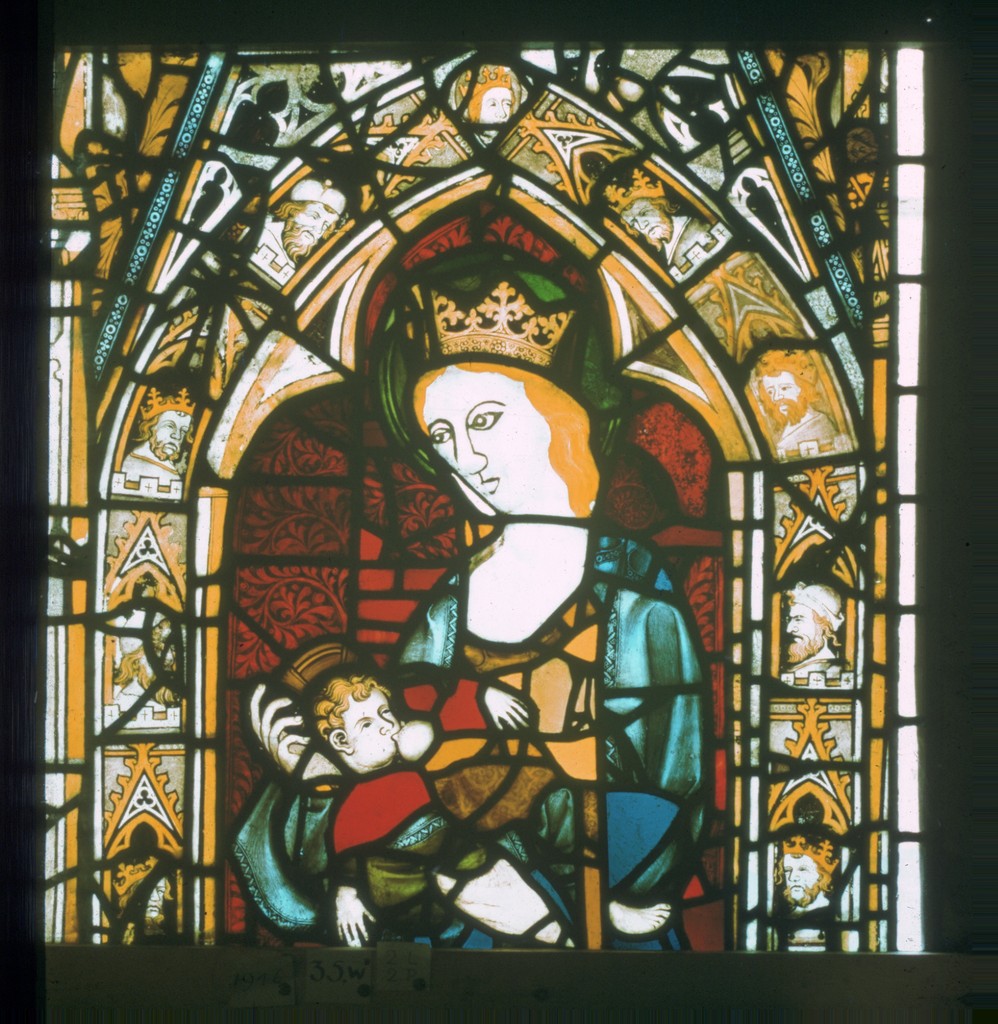


Part of the current debate around public breastfeeding seems to be the perceived eroticism of bared breasts. Renaissance artists guarded against similar criticisms by de-naturalizing the Virgin’s breast. In a 14th-century stained glass window from York Minster Cathedral, Mary’s breast pops neatly out of her tunic and is located close to her navel (left). Round and apple-like, the Virgin’s bare breast often appears to sit on her collar bone, as in the the 12th-century mosaic from Santa Maria in Trastevere, located in Rome (center). Mary might also appear to have only one perfect, plumply rounded breast sitting close to her sternum. In a painting by Joos van Cleve, the Madonna’s engorged breast sprouts from the center of her body (right); no accompanying protuberance is visible underneath her tunic.
What I find interesting about these images is the way that they graft Renaissance concepts of motherhood and female sanctity onto the body of the Virgin. Mary served as a role model and ideal for women, especially mothers. Yet, like any ideal figure, Mary’s spiritual and earthly perfection could not be attained by actual women. Concerns about the care of infants and the role of mothers in feeding and nurturing their children merged with medical concepts of breast milk and the religious import of blood, crystallizing into an impossible image of a one-breasted Mary tenderly feeding her plump and healthy infant.
While the Virgin Mary no longer serves as a ideal, a host of television and movie stars have stepped in to fill the void. Images of women with perfect hair and makeup nursing docile infants grace magazine covers and flood social media platforms. To be clear, I think breast-feeding is great for those women who can make it work, and I fully endorse initiatives to support breast-feeding moms. But, in a strange historical flip-flop, nursing your own child is now a status symbol, and has been shown to be closely linked to class. Wet-nursing has even re-appeared in modern form: lactating mothers can sell their milk as part of the 21st-century gig economy. One thing that has remained constant is the way that we manifest anxieties about motherhood by projecting them onto idealized and unattainable female bodies, whether those are the Virgin Mary’s or Gisele Bündchen’s.
Like this post? Want to know more about Renaissance gender and sexuality? Follow this blog! Next week, we’ll take a look at Simonetta Vespucci, a Florentine noblewoman famed for her beauty, who has recently appeared as a character in the second season of the Netflix series “Medici.”
For more on the Virgin Mary, her breasts, and Renaissance wet nurses, see: Margaret Miles, A Complex Delight: The Secularization of the Breast, 1350-1750 (University of California Press, 2008); Jutta Sperling (editor), Medieval and Renaissance Lactations: Images, Rhetorics, Practices (Ashgate, 2013).
 The Renaissance Uncensored