
Before the advent of the little blue pill, Renaissance men and women turned to apothecaries and folklore in order to attain sexual satisfaction.
The ceramic drug jar above depicts a phallus complete with testicle haunches, bird’s feet and wings, a rabbit’s ears and face, and sporting a bell around its neck. This jar is one of several surviving examples of phallic maiolica related to Renaissance health and virility, and, like the current popularity of Viagra and associated products, poses questions about human health and sexuality.
Following ancient authorities such as Aristotle, Galen and Avicenna, Renaissance physicians believed that male bodies were warm and dry, while female bodies were cold and moist. The superior heat of the male body lead to, among other things, the extrusion of facial hair and reproductive organs, making men active and erect. Women’s frigidity caused both sexual and social passivity, and meant that they needed regular doses of male fluids to maintain a healthy balance. Women who did not have intercourse regularly might become too dry, giving rise to the stereotype of the dried up old crone. At the same time, if men had sex too frequently, they might be drained of their vital fluids and thus become ill. In his Lives of the Artists (1568) Giorgio Vasari claimed that Raphael died from a fever brought on after he indulged “beyond measure in the pleasures of love.”
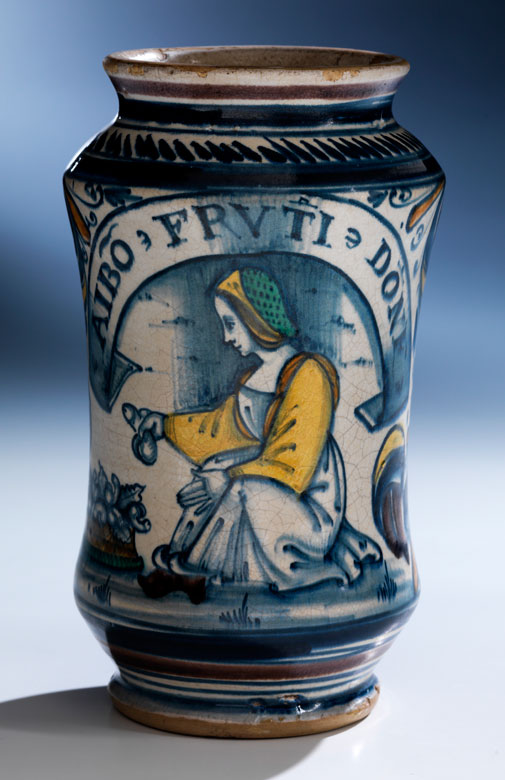
On this late sixteenth-century drug jar from Faenza a woman harvests phalli, plucking them from the field and placing them in a full basket at her feet. The inscription above invites women to “Come get your good fruits.” It therefore echoes the advice of physicians that women routinely seek out men and the healthful fluids they could supply.
This particular motif must have been fairly common, as a remarkably similar image and inscription appear on a plate from about fifty years earlier manufactured in Deruta, a town about 150 miles south of Faenza. What interests me about this scene is its tongue-in-cheek humor. On the one hand, it depicts women’s dependence on the male body, while at the same time suggesting that what women want or need is not men themselves, but only their heated members.

While medical discourses stressed the importance of sexual activity to human health, deep-rooted Mediterranean cultural traditions similarly hailed the male body as a source of fertility and protection. In ancient Rome, winged phalli known as tintinabuli graced the entryways of businesses and homes. They might also be hung with bells to form wind chimes, as in this example from the British Museum. Phalli were associated with fertility and plenty; the agricultural god Priapus possessed a gigantic penis that produced the many “seeds” necessary to grow the bounty of the earth. The male member could also avert the evil eye, a malevolent glare that could cause ill fortune and bodily harm. In combination with the tinkling bells that frightened off evil spirits, the phallic tintinabulum protected the Roman household.

Our jar therefore combines the winged phallus of ancient Rome with two other popular sexual motifs, both of which survive to the current day: the bird and the rabbit. In Italian the word for bird, uccello, is a euphemism for the penis, similar to the English cock. Rabbits likewise retain their Renaissance associations with abundant fertility, and the modern practice of carrying a rabbit’s foot for good luck echoes the ancient Roman use of the fertile phallus to ward off evil.
The jar is also a rather low-cost attempt to mimic Chinese porcelain, which had attained popularity throughout Europe. While it does not have the characteristic luminosity of the original, this jar uses the colors and vegetal and floral motifs that Italians associated with Chinese ceramics.
I have to wonder, then, if this jar held ginseng or “China root,” a species of smilax used to treat syphilis. Renaissance physicians believed that ginseng stimulated the male libido (a quick Google search will reveal that similar beliefs persist today). Syphilis was the first disease that Europeans recognized as being sexually transmitted. Its appearance in Naples in 1495 caused well-placed anxiety; many of the crowned heads of Europe battled the disease, not to mention legions of sailors, soldiers and prostitutes. Other supposed cures for the “French disease,” as it was known, included mercury, which could be applied to the skin, taken orally, or inhaled as a steam; and the wood or gum of guaiacum, a tree native to Hispanola. Neither were very effective, and mercury had the added advantage of driving people mad before it poisoned them.
Moreover, the spout on our jar means that it held liquid contents, and both ginseng and smilax could be prepared as teas or broths. The evil-deflecting and virility-inducing winged phallus and Asian style of this jar would therefore have advertised its healing contents. And you thought that the Trojan condoms commercials were racy.
Like early modern art? Want to know more about the Renaissance body and its bits? Looking for stimulating table talk for your next family dinner? Check back next week! I’ll be looking into the Renaissance fascination with the Virgin Mary and her breasts. Yep, you read that correctly. Madonna mia!
For more on the male body, racy maiolica, and China root check out the following: Patricia Simons, The Sex of Men in Premodern Europe: A Cultural History (Cambridge University Press, 2011); Catherine Hess, “Pleasure, Shame and Healing: erotic imagery on maiolica drug jars,” in Sex Acts in Early Modern Italy, ed. A. Levy (Ashgate, 2010); Anna Winterbottom, “Of the China Root: A Case Study of the Early Modern Circulation of Material Medica,” Social History of Medicine 28:1 (2014).
 The Renaissance Uncensored
