What did Renaissance people see when they looked at nude bodies, voluptuous flesh and sexual acts?
This question is more complex than you might think. Today, we would label images of the eroticized body and coitus as pornography, but in the early 16th century the modern pornography industry had not yet been born. The word pornography didn’t even exist until the 18th century.
I don’t mean to say that images such as the one above didn’t sexually arouse their viewers, but that was not their only purpose. Instead, sexually explicit imagery allowed artists and beholders to explore the relationship between images and their viewers, and the consequences of looking.
So, just what is it that we’re looking at here? This is the eastern wall of the Chamber of Psyche, just one of over twenty frescoed rooms at the Palazzo Te, a villa located in Mantua, Italy. The palace was constructed by Giulio Romano for his patron, Federico II Gonzaga, in the mid-sixteenth century. This particular room is named after the ceiling frescoes, which depict the story of Cupid and Psyche.
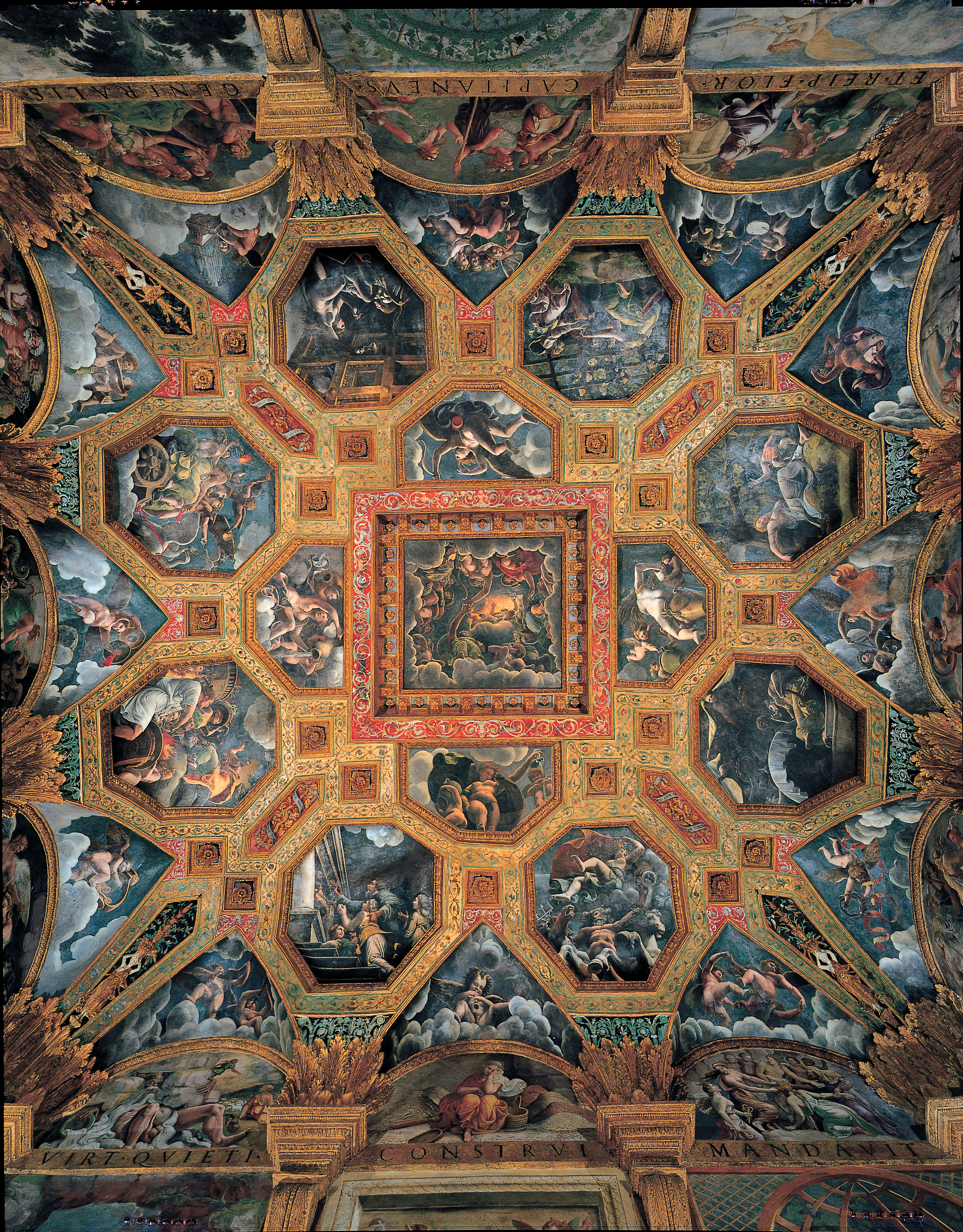
After falling in love with the beautiful mortal, Cupid hides his true identity, coming to her bed only after nightfall. When Psyche has the temerity to sneak a peek at her lover, he flees (upper left octagon). Psyche then undertakes a series of dangerous tasks in order to win him back. She is ultimately successful, and the central scene in the image above depicts Jupiter blessing their union and deifying Psyche. While the story has a happy ending, the lesson here is that looking can be dangerous, especially for a woman.
Located just below the images of Cupid and Psyche, Giulio Romano’s Jupiter and Olympia similarly investigates the role of looking in Renaissance art and culture. The fresco doesn’t leave much to the imagination. This is one of the most explicit images from the sixteenth century, and certainly the most explicit painting from the period. A fully erect Jupiter turns Olympia’s head towards himself, as he prepares to have sex with Olympia, the act that supposedly fathered Alexander the Great. Olympia obligingly hooks her left leg around his torso. Her body is turned outward toward the viewer, and she grips the fictive frame of the painting, perhaps in the throes of ecstasy. Jupiter sports a snake’s tale – he was in the habit of donning various disguises in a vain attempt to hide his adulterous liaisons from his wife, Juno. To the right Olympia’s husband, Philip of Macedon, spies on the couple. For the offense of daring to look upon a god Philip’s eyes are put out by Jupiter’s eagle.

What’s interesting to me here is the way that the image solicits the very act it punishes. It asks us to gaze upon a god in the flesh, as it were. The figures are incredibly sculptural, and the presence of Olympia’s hand on the painted frame only strengthens the feeling that this scene is taking place in the space of the room, right in front of us. In looking at the fresco, we commit the same voyeuristic act as Philip, and we might, therefore, expect to be punished for it. Well, perhaps only if we were men. Jupiter himself seems to license the feminine erotic gaze by turning Olympia’s head so that she looks up at him.

Olympia’s upward gaze counters Renaissance advice to married women and girls, who were admonished to keep their eyes lowered, especially in the company of men. In contrast, Renaissance prostitutes and courtesans were characterized by their bold, inviting gazes. Pietro Bertelli’s Roman courtesan is part of a series of prints depicting the costumes of Roman women. Unlike his images of a maiden, matron or widow, the courtesan gazes enticingly out of the print, acknowledging her beholders. In Bertelli’s print, the courtesan’s visual contact with her beholders licenses their own voyeuristic and erotic looking.
In contrast, Jupiter and Olympia punishes the male gaze, potentially upending the gender norms of the Renaissance. Giulio Romano and Federico II Gonzaga were far from championing women’s rights or equality, but, in practice, the fresco facilitated women’s erotic gazing. Scholars have generally assumed that the viewers of these and other erotic works of art were men, but letters and accounts demonstrate that women were frequent visitors to the Palazzo Te throughout the sixteenth and seventeenth centuries. So, while Olympia is certainly objectified in this image – her nude body is laid bare for the viewer – she also engages in erotic viewing. Her gaze positions Jupiter as sexually alluring, perhaps encouraging Renaissance women to take up a little erotic peeking of their own.
Like this post? If so, check out my book, Gender, Space and Experience at the Renaissance Court. Performance and Practice at the Palazzo Te published with Amsterdam University Press.
You can also sign-up for email notifications. Next week, we’ll probe the Renaissance fascination with the male phallus. Che cazzo!
 The Renaissance Uncensored
Leave a comment